
Panels & wiring
Aluminum branch wiring in 1960s and 70s Birmingham homes
If your house went up between about 1965 and 1975, there is a real chance the branch circuits are aluminum. Here is what that means and what it does not.
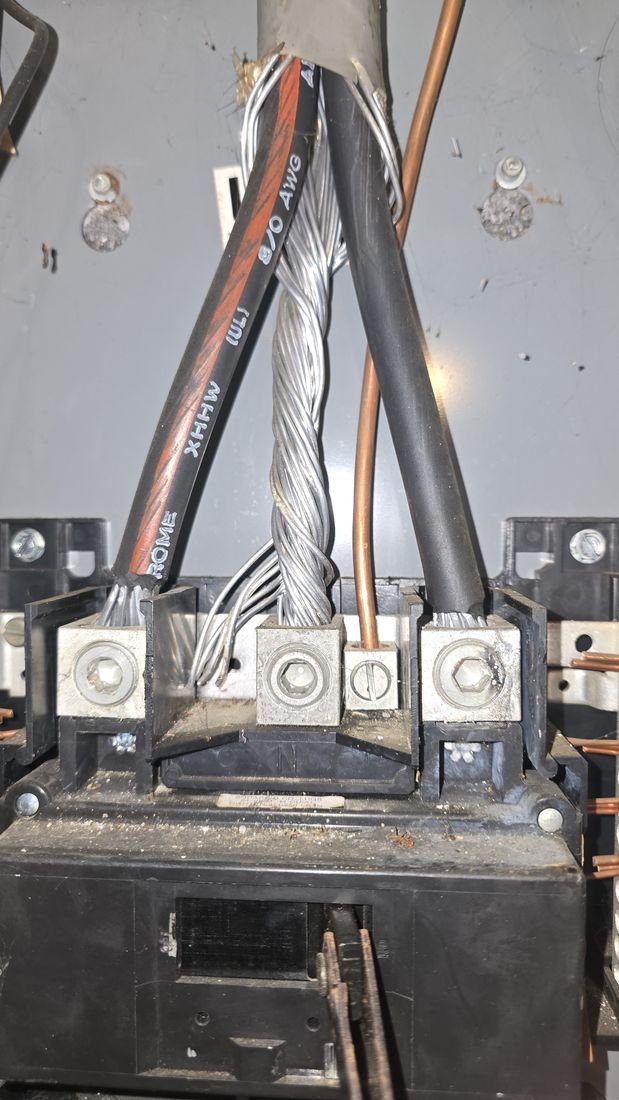
Copper prices spiked in the mid-1960s, and for roughly a decade a great deal of residential branch wiring was run in aluminum instead. A lot of it is in houses around Birmingham, Irondale and the surrounding communities, and most of the owners have no idea.
Aluminum itself is not the problem — service entrance conductors and feeders are routinely aluminum today and perform fine. The problem is aluminum at the terminations on small branch circuits. Aluminum expands and contracts more than copper as the circuit heats and cools, so terminal screws gradually loosen. It also oxidizes, and aluminum oxide is a poor conductor, so the connection gets more resistive, which makes it hotter, which loosens it further. The failure mode is a slow loop, and left alone it ends the way overheated connections end: with charred insulation, a melted device and, in the worst cases, a fire inside the wall. Aluminum branch wiring is a documented fire hazard for exactly this reason, and it is why we treat it as a safety item rather than a cosmetic one.
How many houses around Birmingham are in the window
Nobody keeps a count of aluminum-wired houses by city. What the Census Bureau does count is when houses were built, and the aluminum years, roughly 1965 to the mid-1970s, sit across the 1960s and 1970s. Here is how many housing units in each city date from those two decades, from the 2024 American Community Survey:
- Birmingham: about 31,600 built 1960–1979, or 29% of all housing in the city
- Vestavia Hills: about 5,200, or 35%
- Homewood: about 3,200, or 29%
- Mountain Brook: about 3,100, or 35%
- Irondale: about 3,000, or 45%
- Jefferson County as a whole: about 94,900, or 31%
Roughly half of those went up inside the aluminum years themselves. Not every house from that period got aluminum branch circuits; it came down to the builder, the supplier and the price of copper that month, so there is no honest way to turn these counts into a number of aluminum-wired houses. Nationally, the Consumer Product Safety Commission put it at 1.5 to 2 million homes, and its research found that homes built before 1972 and wired with aluminum are 55 times more likely to have a connection at an outlet reach fire-hazard conditions than homes wired with copper. Around here that means tens of thousands of houses are the right age to have it, and the only way to know about yours is to look.
What is worth doing
If the house can reasonably be rewired, that is the option we prefer: new copper branch circuits, and the aluminum removed or disconnected and documented. Where it is reasonable depends on access. A house with an open attic and an accessible crawlspace can often be rewired without opening much plaster. One built on a slab, with finished ceilings and no way into the walls, usually cannot be, at least not at a price that makes sense.
When most of the house is not easily accessible, the accepted repair is correcting every termination instead — either devices rated CO/ALR, or pigtailing to copper at each box with connectors specifically listed for aluminum-to-copper — and adding protection on top of it: combination arc-fault (AFCI) breakers, which are built to catch the arcing a loosening aluminum connection produces before it becomes a fire, and ground-fault (GFCI) protection where the code calls for it. Standard wire nuts are not that, and twisting aluminum to copper under an ordinary wire nut is the most common do-it-yourself mistake we see on these houses; it creates the same loose, overheating joint the repair is meant to remove. It is tedious rather than difficult, and it is priced per device because that is genuinely what the labor is.
What is not acceptable is a standard receptacle on aluminum wire, which is what we find most of the time, usually installed by a previous owner who had no idea there was a distinction. If your house is from that era, this is worth checking before you sell, because a home inspector will find it.